New research finds drawing linked to famous fossil hunter, Mary Anning, at the Yorkshire Museum after two centuries.
Date: 30 April 2026
New research finds drawing linked to famous fossil hunter, Mary Anning, at the Yorkshire Museum after two centuries.
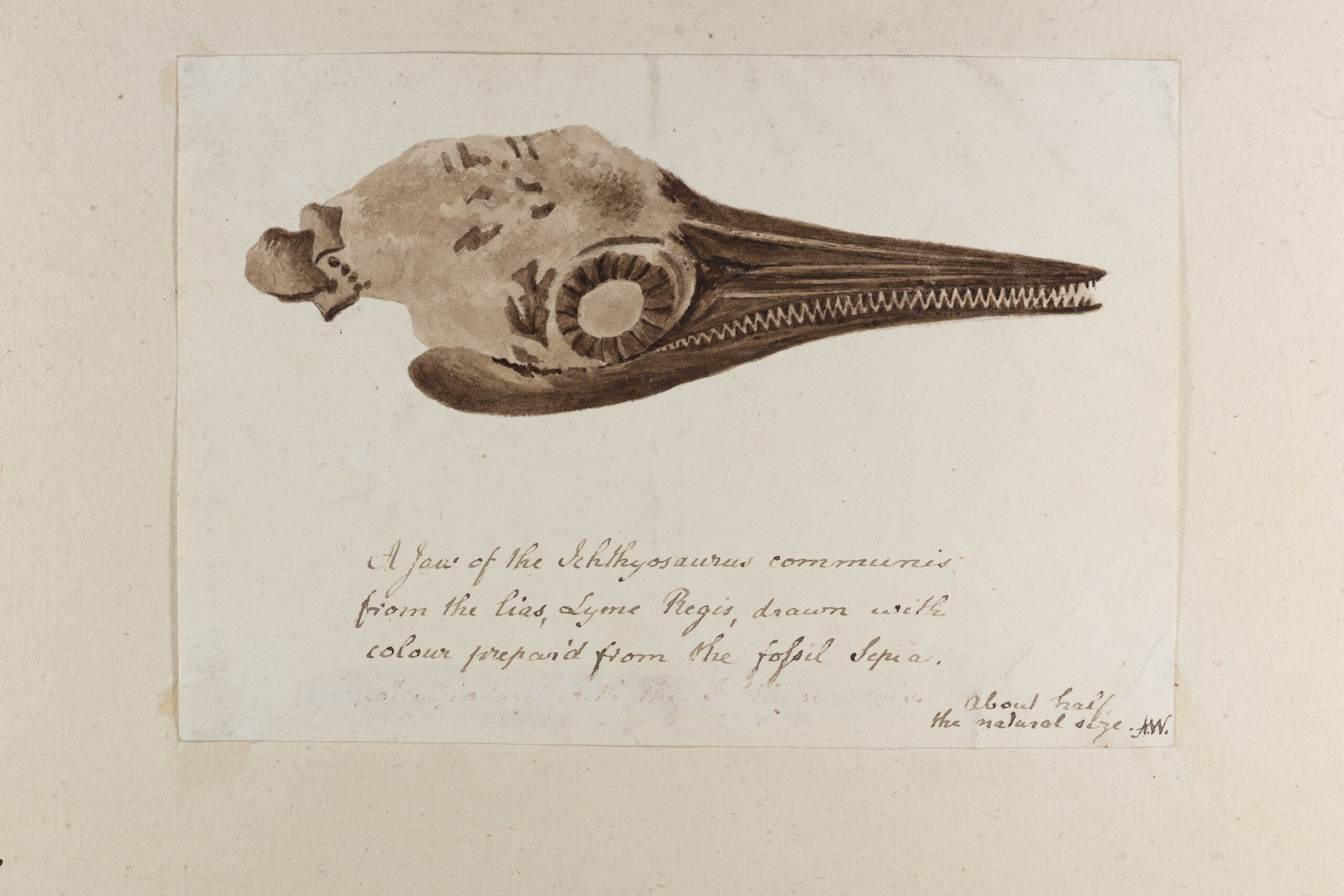
New scientific research has uncovered a paper trail in Yorkshire linking back to famous eighteenth-century fossil hunter, Mary Anning. Explorations into Lyme Regis, Mary Anning and the drawings and letters of Elizabeth Philpot – led by Tom Sharpe, Hugh Torrens and Sarah King – has unveiled a highly significant, and previously unpublished, drawing within the Yorkshire Museum’s collection.
In 1833, a drawing of an ichthyosaur skull by Yorkshire woman, Anne Wickham, was sent to the Yorkshire Museum’s then keeper, John Phillips, along with a letter. Both have been re-discovered in York, the first at the Yorkshire Museum and the latter in the York Philosophical Society’s collection at the University of York’s Borthwick Archive. Wickham’s drawing had been done in fossilised sepia ink, obtained from the ink sacs of fossilised cephalopods, a popular medium during the eighteenth and nineteenth centuries. Her letter gives, for the first time, the recipe for reconstituting fossilised sepia for use as an ink, providing valuable insight into the other published drawings from Philpot’s collection.
Drawings in fossilised sepia ink have long been studied for their connection to Lyme Regis and subsequently Mary Anning. The drawing and letter from Yorkshire confirm existing evidence about how this ink was obtained and provides new insight into the production of the sepia ink drawings.
Dr Sarah King, Curator of Natural Sciences at York Museums Trust commented; “The Yorkshire Museum has held Wickham’s drawing since 1833, but it has been unknown and unpublished for almost two centuries. Diligent research efforts have enabled us to track down the drawing and accompanying letter, which reveals more about the network of women interested in and writing about palaeontology in the eighteenth century.”
The Yorkshire Museum currently has an exhibition dedicated to Mary Anning and her pioneering efforts, and King elaborates, “Research and exhibitions like this are a wonderful thing, celebrating women in science and recognising the importance of Anning to these practices of recording fossilised specimens. To connect other women in York and the Yorkshire Museum to Anning has been a hugely exciting endeavour.”
Tom Sharpe, an expert on Mary Anning and the driving force behind this recent research, said “Working with different partners and institutions is always so exciting and rewarding, especially when a collective effort reveals something fascinating. Having worked with the Yorkshire Museum in the past on the Mary Anning Rocks! exhibition, it was a delight to discover more links to her and her livelihood within the Yorkshire Museum’s collection. Tracing the letter to the Borthwick Archives was also a special moment during the research process. The power of connections, museum archives and scientific networks has enabled this to come to light and solidify what we already know about the other sepia drawings and reveal more about the breadth of Anning’s influence on palaeontology.”
The research paper has now been published and is available to read on the Yorkshire Museum’s website. The Mary Anning Rocks! exhibition is currently on display at the Yorkshire Museum and is included in general admission.
ENDS
For more information or high-res images please contact:
Amy Cope
Public Relations Officer
Email: amy.cope@ymt.org.uk
Phone: 07761634646